
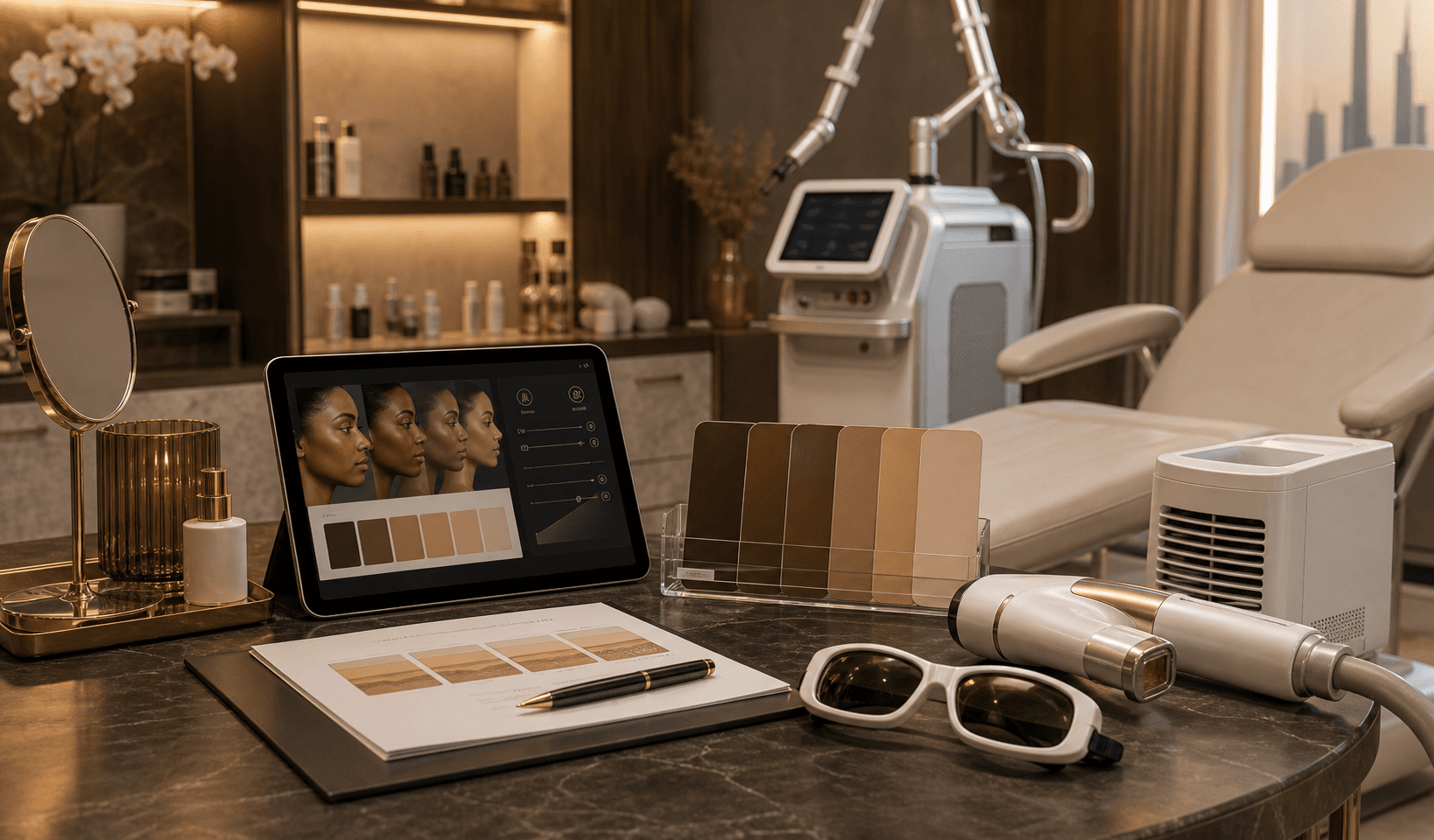
Why is darker skin more sensitive to laser?
Many lasers target melanin. Darker skin tones (Fitzpatrick IV–VI) have more melanin in the skin itself, so there's a greater chance the laser energy is absorbed by the skin rather than only the intended target — which can lead to burns, or to pigmentation changes (lightening or, more often, post-inflammatory darkening). This is a real risk, not a reason to avoid laser altogether — but a reason to choose carefully.
How is laser made safe for darker skin?
Several factors work together:
- Appropriate wavelengths— e.g. Nd:YAG (1064nm) penetrates without overheating the surface, making it better suited to darker tones
- Conservative settings— energy and pacing tailored to your skin type
- Cooling— protects the skin's surface A patch test — confirms how your skin responds before a full treatment
- An experienced operator— who understands melanin-rich skin On the right protocol, many laser treatments (hair reduction, certain pigmentation work, rejuvenation) can be done safely. [cite: peer-reviewed / device manufacturer]
Which treatments need extra caution?
Some concerns warrant particular care on darker skin — notably melasma and pigmentation, where aggressive laser can worsen things, and any resurfacing. Often the safest plan starts gentler (e.g. conservative settings, or pairing with non-laser approaches) and builds cautiously. "More aggressive" is not "more effective" here — restraint protects you.
What should you look for in a clinic?
Ask: Does the clinic have devices suitable for my skin tone (e.g. Nd:YAG capability)? Will they assess my skin type and do a patch test? Who performs the treatment and are they experienced with darker skin? Beware one-size-fits-all packages and anyone who doesn't assess your skin first. The clinic's experience with melanin-rich skin is the single biggest safety factor. We treat tone-aware care as standard — see our laser treatments.