
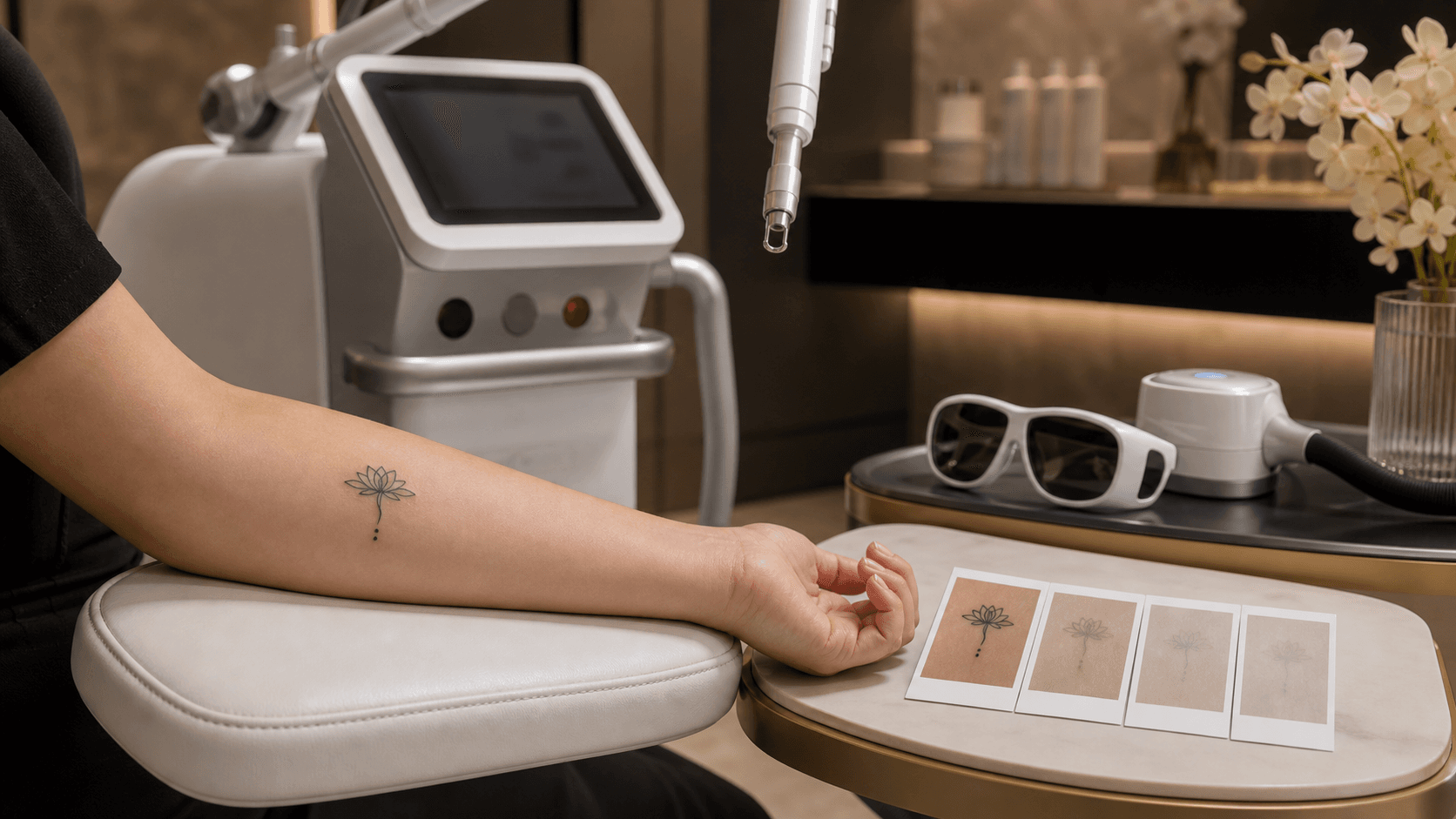
How does laser tattoo removal work?
A Q-switched laser (such as the Hollywood Spectra) delivers energy in very short pulses that shatter the tattoo ink into tiny particles. Your immune system then gradually removes those particles over the following weeks — which is why fading is progressive and why sessions are spaced out to give your body time to clear the ink. See the tattoo removal service.
How many sessions will I need?
This varies a lot, and honesty matters here: most tattoos need several sessions, sometimes more, spaced weeks apart. Factors that affect the number include:
- Ink colour— dark inks (black) typically respond better; some colours are more stubborn
- Ink density and depth— heavier, deeper tattoos take longer
- Age and type— older, faded, amateur and professional tattoos differ Your skin and immune clearance Your clinician gives a realistic estimate after seeing your tattoo — beware anyone promising a fixed small number sight-unseen.
Does it hurt?
Most people describe it as uncomfortable but tolerable — often likened to a hot elastic-band snap, more intense than getting the tattoo for short bursts. Cooling and (where appropriate) numbing options help, and because each pass is quick, it's manageable. Sensation varies by person and area. Your clinician will discuss comfort measures.
What results are realistic?
The honest answer: significant fading is achievable for many tattoos, but complete removal can't be guaranteed and depends on ink, colours, depth and your skin. Some tattoos fade almost completely; others lighten substantially but leave a faint shadow. Realistic expectations — and patience across a course — are essential. Results vary by individual.
Is it safe, and what about aftercare and darker skin?
On the right settings, Q-switched laser is well-established for tattoo removal, and settings are tailored to your skin tone (darker skin treated conservatively). Aftercare matters: keep the area protected, follow wound-care guidance, and use diligent sun protection between sessions — important in Dubai. Your clinician will guide each step.