
How does Dubai's climate affect your skin?
Several factors combine here that you wouldn't face in a milder climate. Strong ultraviolet (UV) radiation is present for most of the year, driving pigment production, premature aging and sun damage. Heat — and even infrared and visible light — can stimulate pigment-producing cells independently of UV, which is one reason pigmentation is so common locally. Humidity swings between sticky summers and drier months, while heavy indoor air-conditioning quietly dehydrates the skin barrier. The result is a population of skin concerns dominated by pigmentation, dehydration, sensitivity and sun damage.
What are the most common skin concerns in Dubai?
The concerns we see most often cluster around a few themes:
- Pigmentation and melasma— driven by UV and heat; often the single most common complaint.
- Dehydration and a compromised barrier— from AC, hot showers and sun.
- Sun damage and early aging— fine lines, dullness and uneven tone.
- Acne and congestion— heat, sweat and sunscreen can play a role.
- Sensitivity and redness— sometimes worsened by harsh products or aggressive treatments. Each of these has a dedicated guide in this section; this article is your starting point.
The non-negotiable: daily sun protection
In this climate, sun protection is the foundation of every skincare routine and every treatment plan. A broad-spectrum SPF (high factor), applied every morning and reapplied through the day, does more to protect your skin's tone and slow visible aging than any single treatment. Because heat and visible light also drive pigment, formulations that offer protection beyond UV alone — and physical habits like hats, sunglasses and shade during peak hours — matter too. [cite: AAD / DHA sun-safety guidance]
Building a climate-appropriate routine
A simple, consistent routine usually outperforms a cupboard of products:
- Morning: gentle cleanse → antioxidant serum (e.g. vitamin C) → moisturiser suited to the season → broad-spectrum
- SPF. Evening: cleanse (double-cleanse if you wear SPF/makeup) → any active prescribed by your dermatologist → moisturiser.
- Hydration: lighter textures in humid months, richer ones when AC dries the skin. Actives like retinoids or pigment-correctors can be powerful but should be introduced carefully — ideally on a dermatologist's advice — to avoid irritation that can itself trigger pigmentation.
When should you see a dermatologist?
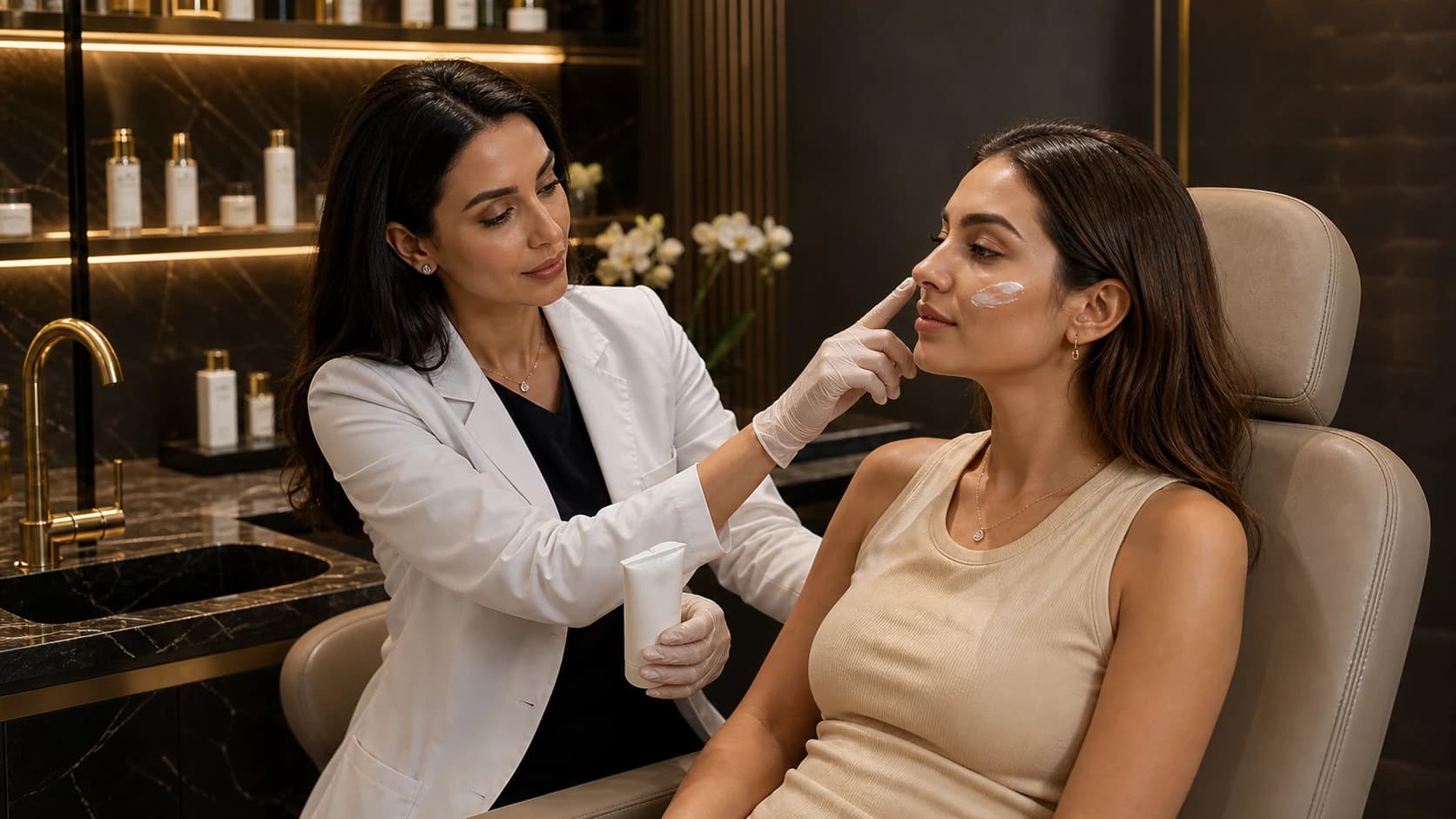
Over-the-counter care manages a lot, but book a professional assessment if you have stubborn pigmentation or melasma, persistent acne or scarring, rosacea or unexplained redness, or simply want a plan built for your skin type rather than guesswork. A appointment matters most here because the wrong treatment — especially an overly aggressive one on darker skin — can worsen pigmentation rather than improve it. Our dermatology appointment is the starting point.
Which professional treatments suit Dubai skin?
The most climate-appropriate treatments are usually gradual and tone-aware rather than aggressive: medical-grade chemical peels, carefully chosen laser and light treatments, skin boosters and hydrating facials for the barrier, and targeted plans for pigmentation and acne. What's right for you depends on your skin type, concern and how much sun exposure you get — which is exactly what an appointment establishes. Individual results vary.