
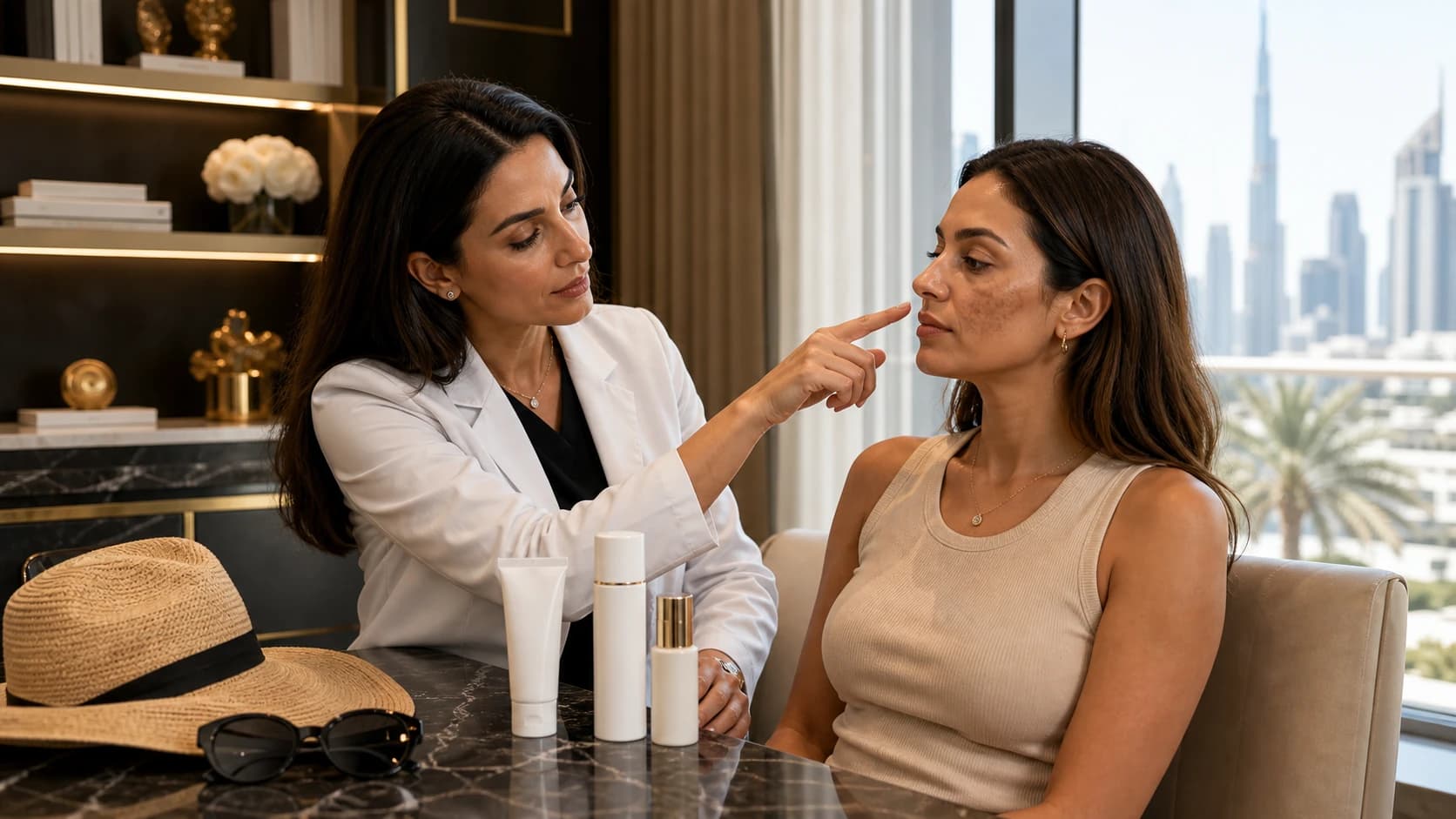
Why does Dubai's climate trigger melasma?
Melasma flares when pigment-producing cells (melanocytes) become overactive.
- Several local factors push them in that direction: intense UV for most of the year, high ambient heat, and visible and infrared light — all of which can stimulate pigment, sometimes independently of
- UV. Heat is the part people underestimate: hot commutes, workouts, cooking and even sweating off your sunscreen can all keep the skin in a "pro-pigment" state. This is why even diligent sunscreen users can struggle if heat exposure is high.
Does sunscreen alone fix it?
Sunscreen is essential but rarely enough on its own here. Because heat and visible light contribute, melasma management usually layers several habits: a high broadspectrum SPF reapplied through the day, physical protection (hats, sunglasses, shade at midday), heatavoidance where realistic, and a dermatologist-guided topical routine. Skipping any one layer makes the others work harder.
How is melasma managed safely in this climate?
The guiding principle is gentle and gradual. A typical dermatologist-led plan focuses on control and fade rather than aggressive clearance: Strict daily photoprotection as the foundation Topical pigment-control prescribed and supervised by a dermatologist Conservative in-clinic treatments — measured chemical peels, and carefully chosen, low-aggression laser settings only where appropriate — spaced widely apart Regular review and seasonal adjustment Because over-treatment can worsen melasma (especially on darker skin), restraint is a feature, not a limitation, of good care. [cite: peer-reviewed melasma management review]
Will my melasma come back?
It can. Melasma is a chronic, relapsing condition, so most people need ongoing maintenance and consistent sun protection to hold their gains — particularly through Dubai's summers. Thinking of it as long-term management, rather than a one-off treatment, sets realistic expectations and better results. Individual results vary.
When should you see a dermatologist?
If your melasma is spreading, not responding to your routine, or you're tempted by strong treatments you've seen advertised, get an assessment first. A dermatologist will confirm it's melasma (and how deep it sits), then build a plan matched to your skin tone — which is the safest way to avoid making it worse. See our pigmentation and melasma treatment options or book a dermatology appointment.